
Satta King Game Explained: What It Is, How a Draw Works and Where It Stands in Law
Guide updated · Satta King Ultra Fast
The Satta King game is a daily number draw played across north India: each named draw, or "bazar", declares one two-digit number from 00 to 99 at a fixed time, and people who have bet on that number are paid by the person who took the bet. This page explains where the game came from, how a draw is actually run, what the words around it mean, why the odds are built against the player, and what Indian law says about it.
It is written for readers who want to understand the thing their family, neighbours or chat groups talk about, not for players. This site shows published results and charts and does nothing else. The board of all draws has today's and yesterday's number for every draw.
What the Satta King Game Is
Strip away the names and the game is simple. A draw has a name, such as Gali, Disawar, Faridabad or Ghaziabad, and a published time. Once a day, at that time, the people who run the draw declare a number between 00 and 99. That number is the result, and it is the only thing a result site like this one records.
Before the draw, a bettor picks a number and hands money to a local bookmaker, usually called a khaiwal, who writes it in a book. After the draw, a bettor whose number matched is paid a multiple of the stake, and everyone else loses the stake. There are more than a hundred named draws across the day, each with its own time and its own number, and the result page lists them in the order they open.
"Satta King" originally meant the person who won a draw, the king of the satta. Over time it became the name for the whole game and then the name of the websites that publish the numbers. When people say "Satta King game" today, they usually mean the four big Delhi-NCR draws and the hundred smaller ones that follow the same pattern.
Satta King Game History: From Satta Matka to the Delhi Draws
The game descends from Satta Matka, which began in Mumbai in the early 1960s. At first people bet on the opening and closing cotton rates sent from the New York Cotton Exchange to the Bombay Cotton Exchange. When that feed stopped, organisers replaced it with numbered slips drawn from an earthen pot, a matka, and the name stuck. The full story is on Wikipedia's Satta Matka page.
Matka grew enormous through the 1970s and 1980s, then shrank after police action in Mumbai in the 1990s. Around the same time a simpler version took hold in Delhi and the towns around it: one two-digit number per draw, no opening and closing panels, and a name taken from a place. Disawar, Gali, Faridabad and Ghaziabad are the four that grew largest through the 1990s and 2000s, and they remain the ones most people check.
The websites came last. Once results could be posted online, "Satta King" became a brand name for result boards and record charts, and the name spread far beyond Delhi. Today a reader in Punjab, Bihar or Rajasthan searches for the same four draws, plus dozens of local ones that borrowed the format.
Why the names are places
Each draw was originally run from a town or a neighbourhood, and the name told bettors which book they were betting in. The place names no longer mean much; a draw called Faridabad is followed across north India and is not run by the city in any sense. The Delhi result page sorts out the many draws that carry the capital's name.
How a Draw Is Run, and Why There Is No Company
A draw is run by a small group of people, offline. At the published time they declare a number and pass it to the khaiwals who took bets on their book, and from there it reaches chat groups and result sites. There is no public drawing, no machine you can watch and no auditor. The number comes out when the people say it does, which is why a result can be late by a few minutes or, rarely, missing for a day.
Because the whole thing is informal, there is no company behind any draw, no registration, no licence and no customer service. There is also no "company result" or "head office", despite what some chat messages claim. Every result site, including this one, is simply copying a number that was announced elsewhere. When sites disagree, it is because one of them copied a wrong number or a different draw with a similar name.
This matters for two reasons. First, nobody outside that small group can know the number early, which is why every "leak" for sale is a guess. Second, a bettor has no recourse if a khaiwal does not pay. There is no complaint desk for an illegal game.
What a result site actually does
A result site waits for the declared number, records it beside the draw name and time, and adds it to the month's chart. That is the whole job. On this site the board refreshes every minute while the page is open and shows the real time of the last update, so you can tell a fresh Satta King game result from a stale one. Nothing is predicted, and nothing is changed after the fact.
Satta King Game Vocabulary
The game has its own words, mostly Hindi and Urdu, and they appear on every board and in every chat group. The table explains them as terms only; it is not a guide to playing.
| Term | Meaning | Where you meet it |
|---|---|---|
| Jodi | A two-digit number from 00 to 99. The result of a draw is one jodi. | Every result board cell and chart cell. |
| Haruf | A single digit, 0 to 9. Bettors speak of the first digit and the second digit of a jodi. | Chat groups, khaiwal books. |
| Andar / bahar | Hindi for inside and outside: the first digit and the second digit of a jodi. | Chat groups, old-style boards. |
| Bazar / bajar | Market. The name of a draw, as in Delhi Bazar or Gali Bazar. | Draw names on the board. |
| Khabar | News. In this world it means today’s number, and in scams it means a number claimed before the draw. | Searches, chat groups. |
| Record chart | The month-by-month list of past results for one draw. | Chart pages on this site. |
| Khaiwal | The local bookmaker who takes bets and pays winners. This site has no connection to any. | Chat groups, local talk. |
| 786 | A number many site names carry as a blessing. It does not change any draw. | Site names, not results. |
| Satta King | Originally the winner of a draw; now the game and the result sites. | Everywhere. |
The 786 page and the Black Satta King page cover two of these in depth, because both names confuse readers into thinking they are separate draws. They are not.
The Odds in Plain Words
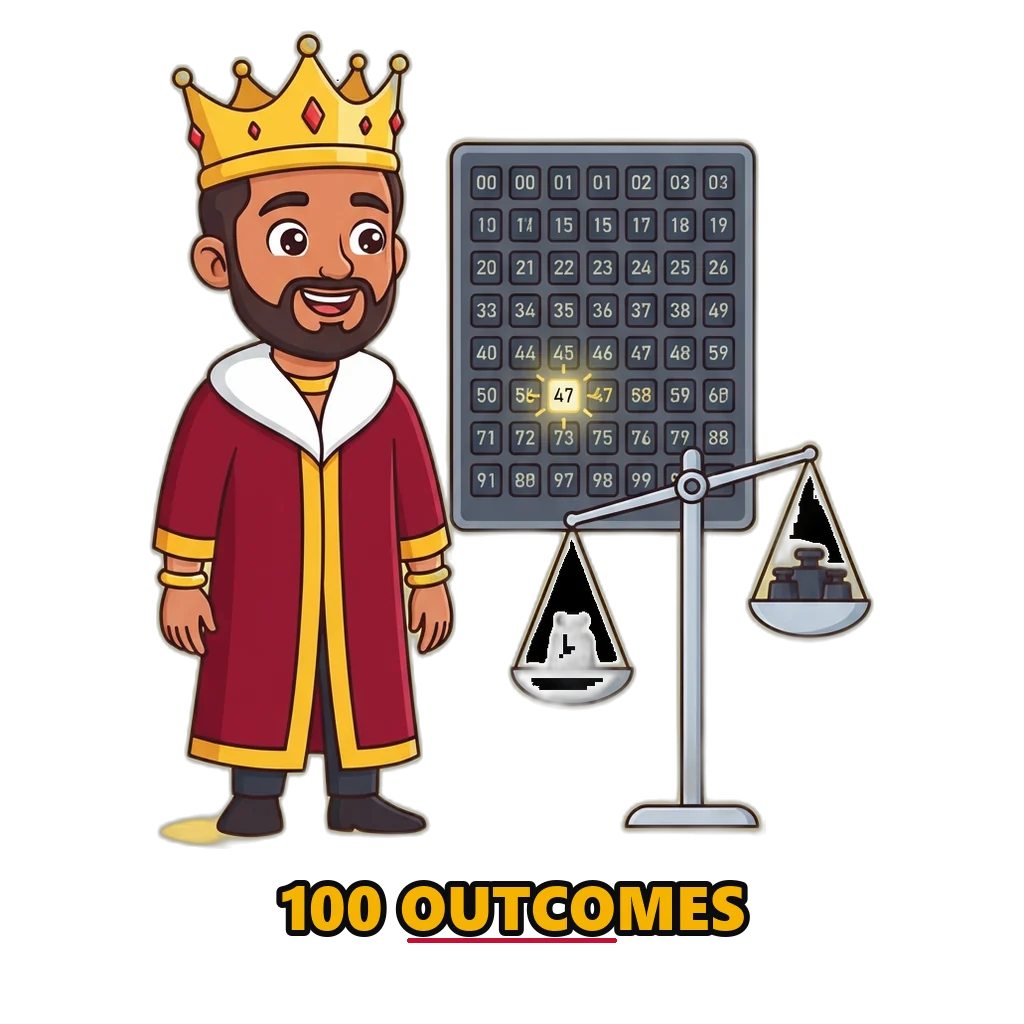
A two-digit draw has exactly 100 possible outcomes. If the draw were fair and random, a bettor who picked one number would be right one time in a hundred. A fair payout, the one that would leave a bettor level over time, would therefore be 100 times the stake. Nobody offers that.
The multiple commonly quoted around these draws is about 90 times the stake for a matched jodi. That gap between 90 and 100 is the house margin, and it is where the money goes. Over a hundred bets of the same size, the bettor expects to win once, collect 90 stakes, and lose 99 stakes, for a net loss of about 10 per cent of everything wagered. Single-digit bets are quoted at lower multiples and the margin works the same way.
| Type of bet (as a term) | Possible outcomes | Fair multiple | Commonly quoted multiple | Expected loss on every 100 units bet |
|---|---|---|---|---|
| Jodi (two digits) | 100 | 100× | About 90× | About 10 units |
| Haruf (one digit) | 10 | 10× | About 9× | About 10 units |
| Any bet, repeated daily | Independent each day | Never changes | Never changes | The loss adds up with every bet |
Two further points make the Satta King game worse than the table suggests. The draw is not a verified random process, so the bettor cannot even be sure that each number has a one-in-a-hundred chance. And the payout is a promise from a bookmaker in an illegal game, so a win can simply go unpaid. The arithmetic says you lose slowly; the setting says you may lose faster.
Charts do not change the odds
Each day's draw is independent of the one before. A number that has not come for a month is not "due", and one that came twice last week is not "hot". The monthly chart page explains what the record chart is for: confirming what came, not predicting what comes next.
Legal Status of the Satta King Game in India
Betting on these draws is illegal in most Indian states. The base law is the Public Gambling Act of 1867, which penalises running or being found in a "common gaming house", and most states have their own gambling acts built on it, some with heavier penalties. Gambling is a state subject under the Constitution, so the exact rules and punishments vary by state, but the number game is not legal in any of them. The text of the 1867 Act is on the India Code portal.
Online, the position became uniform in 2025. The Promotion and Regulation of Online Gaming Act prohibits online money games across the whole country, including advertising them and processing payments for them. That closed the door on any app or website that offered the Satta King game as an online bet, and it is why this site has no betting feature and never will.
Reading a published result is not an offence. Publishing a record of numbers that were declared is information, in the same way that reporting the outcome of any event is. What the law reaches is the betting, the bookmaking and, since 2025, the online money game itself.
What this means for a reader
- A khaiwal who takes your bet is committing an offence, and so, in most states, are you.
- No court will help you recover an unpaid win from an illegal game.
- Any app offering the game online is breaking the 2025 Act, and your money in it has no protection.
- If someone has defrauded you around the game, the fraud itself is reportable on 1930 or at cybercrime.gov.in, whatever the game's status.
Why This Site Only Publishes Results
Satta King Ultra Fast shows the numbers that were declared, the time each draw opens and the monthly record chart. It does not take bets, does not sell or send numbers, has no login and no app, and does not link to anyone who does. Those limits are not caution for its own sake; they follow from everything above.
The draws are run by people who answer to nobody, so the only honest thing a site can offer is a record of what they announced. The odds guarantee that anyone who plays long enough loses. The law forbids the bet. A site that stays on the information side of that line can be useful; a site that crosses it is part of the problem. The Satta King khabar page shows what the other side looks like.
Satta King vs Satta Matka vs a State Lottery
Readers often lump these three together, and the differences matter.
Satta King is the north-Indian single-number draw described on this page: one jodi per named draw per day, run offline by private people, illegal to bet on.
Satta Matka is the older Mumbai game with opening and closing panels and more bet types. The Kalyan and Main Mumbai draws are the best known. It is also run privately and is also illegal to bet on; the mechanics are more complex but the legal position is the same.
State lotteries are different in kind. A handful of states, such as Kerala, Punjab, Sikkim and West Bengal, run paper lotteries under the Lotteries (Regulation) Act of 1998, with printed tickets, public draws, published rules and tax on prizes. They are legal in the states that run them and illegal to sell in the states that ban them. Nothing on this site is connected to any state lottery, and no Satta King draw is one.
The simplest test: a state lottery has a government department, a printed ticket and a published draw procedure. The Satta King game has none of the three, and a site that calls a Satta King game draw a "lottery" is borrowing respectability it has not earned.

Stay Safe: Information, Not Advice
Everything on this page is information about how the game works, not an invitation to play it. Betting on these draws is illegal in most Indian states, the people who run them are accountable to nobody, and the arithmetic means a regular player loses over time. Never pay for a number, never share a UPI PIN or an OTP to "receive" one, and if the game is already costing you money or peace of mind, free and private help is on 14416.
18+ only. Betting on number games is illegal in most Indian states. This site shows published results for information; no number is a prediction, a tip or a guarantee. If gambling is affecting your money, sleep or mood, Tele-MANAS offers free, private help on 14416. Read the safety and law page.
See what the draws declared today
The main board lists every draw with its published time, today's and yesterday's number, and an honest update stamp.
Frequently Asked Questions
What is the Satta King game in one sentence?
It is a daily number draw in which each named draw declares one two-digit number from 00 to 99 at a fixed time, and people who bet on that number through a local bookmaker are paid a multiple of their stake. Betting on it is illegal in most Indian states.
Is Satta King the same as Satta Matka?
No. Satta King descends from the 1960s Mumbai game Satta Matka but uses a single two-digit number per draw instead of opening and closing panels. Both are run privately and both are illegal to bet on.
Who runs the Satta King draws?
Small groups of private people, offline. There is no company, no licence, no registration and no customer service. Every result site, including this one, only copies the number those people announce.
Can anyone know the number before the draw?
No. The number is decided by the people who run the draw at the published time. Anyone selling a leak or fixed number is guessing and charging for the guess.
Is it legal to read Satta King results online?
Reading a published result is information and is not an offence. Betting on the draws is illegal in most states, and betting through any website or app has been prohibited across India since 2025.
Why do players lose over time?
A two-digit draw has 100 outcomes, but the payout commonly quoted is about 90 times the stake. That gap means a regular bettor loses about one-tenth of everything wagered in the long run, before counting unpaid wins.
Conclusion: The Satta King Game Without the Myths
The Satta King game is a two-digit draw run offline by private people, descended from Mumbai's Satta Matka and now centred on Gali, Disawar, Faridabad and Ghaziabad. There is no company, no licence and no early number; the odds are set so the player loses; and the bet is illegal in most of India and prohibited online everywhere. What is lawful and harmless is reading what was declared, which is all the board on the home page and the draw pages do.
Related Pages
- Satta King HomeToday’s results, the monthly chart and every guide in one place.
- Satta King ResultToday and yesterday for every draw, with times.
- Satta King ChartMonthly record chart for the four main draws.
- Satta King KhabarToday’s update and why “fixed numbers” are a scam.
- Safety and the LawLegal status, risks, scams and free help.
- Satta King FAQShort answers to common questions.